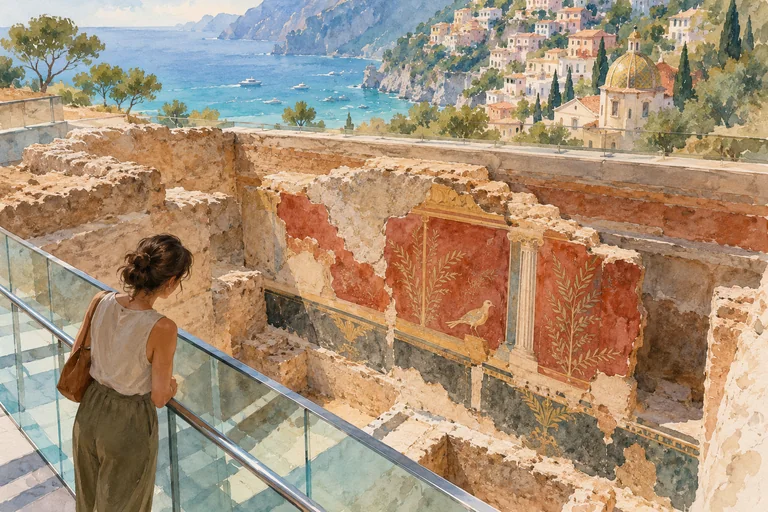
Atrani from Sorrento: how can a small town become a complete excursion?

Atrani becomes more rewarding when you stop treating it as a quick photograph beside Amalfi. From a Sorrento base, the journey deserves a clear purpose: a small town walk, an attentive look at two churches and enough time to sit without calculating the next stop. Small does not mean effortless to reach, and a short distance on a coastal map does not establish a suitable walking route or transport connection.
Plan Atrani as its own destination. Decide how you will arrive, where the final local connection ends and how you will return to Sorrento. Then let the town’s own history shape your visit, rather than expecting a miniature version of the better-known neighbor.
Start with a church that changed its appearance
The municipality describes San Salvatore de’ Birecto as a church built in the tenth century, with an original entrance facing west. The present facade, clock, staircase and atrium belong to later Baroque changes. This makes the building a useful exercise in separating an institution’s age from the age of its visible frontage.
Look first at the relationship between the steps and the public space. How does an entrance organize the way people approach, pause or pass? You do not need to establish every construction phase to notice that a church participates in the daily life of the town around it.
According to the municipal account, San Salvatore served as the palatine chapel during the Amalfi republic, associated with the coronation of dukes. That is a specific civic role, not a reason to turn every detail into a ducal relic. Keep the documented history attached to the building and ask the labels or local guide to explain particular objects.
Follow an object without assuming it remains in place
One especially useful detail concerns the bronze doors dated to 1087. The municipality states that they are now kept at Santa Maria Maddalena. An object’s historical association and its current location are therefore different facts. A photograph or older description can easily blur them.
If seeing the doors is important to you, confirm their present display and the church’s access before travelling. A municipal place record marked for free access is not a timetable guaranteeing an open door at any hour. Worship, maintenance and local arrangements still matter.
This is the same kind of careful distinction discussed in our Sorrento Cathedral guide: an interesting inventory should help you ask better questions, not encourage you to insist on access to every space.
Give Santa Maria Maddalena a separate look
The official municipal history dates the foundation of Santa Maria Maddalena to 1274 and describes several later interventions, including enlargement in the eighteenth century. The resulting building can be read as a sequence of decisions rather than a single untouched moment.
Observe the outline and the relationship between the building and its surroundings before concentrating on individual works. If the church is open, choose one feature identified by an on-site label and spend a few minutes with it. Do not assume that a terrace, sacristy or viewpoint mentioned in a historical description forms part of ordinary visitor access.
A visit can remain worthwhile even when an interior is unavailable. Looking at the approaches, recording a question and returning to the municipal history later is better than trying to push a closed door into your itinerary. Living towns are not exhibition routes with every element synchronized for visitors.
Make the journey part of the decision
Our road-or-sea guide from Sorrento explains why transport choices should be evaluated separately from the appeal of the destination. Check current operator information for your date, any interchange and the final approach. Do not infer a direct boat to Atrani from a service advertised to Amalfi.
Allow a return margin that reflects the actual service you intend to use. Weather can affect sea travel, and a convenient outward connection does not guarantee a similarly convenient journey home. If mobility needs affect your plans, ask about slopes, steps and the exact arrival point rather than relying on a town’s small footprint.
For comparison, Ravello from Sorrento represents a different kind of coastal excursion. Choose between their particular interests instead of collecting both names simply because they appear close on a map. Our Amalfi Coast experiences show itineraries whose actual stops and free time should be checked carefully.
If you enjoy following architecture through successive uses, Naples’ city journal provides useful comparisons beyond the peninsula. Atrani itself needs no larger itinerary to justify the day. Two buildings, a traceable object and a calm return plan are already a substantial visit.
Sources & further reading
Turn a good read into a great day.
Find a highly rated Sorrentine experience that brings these stories to life.
Explore related experiences →