Minori’s Roman villa is closed: what should Sorrento visitors plan instead?

If the Roman villa is your main reason for travelling from Sorrento to Minori, change the plan before buying transport. Checked on 24 October 2026, the Ministry of Culture’s official record still lists the villa and Antiquarium as closed to visitors. Its notice says the temporary closure began on 25 August 2025 for conservation and restoration work. It does not provide a confirmed reopening date.
That is the starting point for a useful article, rather than a footnote beneath an inviting description of rooms you cannot currently enter. Minori remains a town on the Amalfi Coast, but a town excursion and a visit inside its archaeological site are different propositions.
Let the closure notice govern your itinerary
The ministry describes work on decorated surfaces, mosaics and ancient structures, together with improvements to visitor routes and accessibility. Those intended improvements explain the project; they do not establish that a new route is already available. Older photographs, timetables and ticket descriptions cannot override the current closure notice.
The municipal tourism pages still include itineraries that mention entering the villa. They are useful for understanding the place, but their general wording should not be treated as a current admission confirmation. When two pages serve different purposes, look for the operator’s explicit access notice rather than choosing the more convenient version.
Before any future journey specifically for the villa, check the ministry record again and seek confirmation from the institution. A reopening announcement should identify when visits resume and what arrangements apply. Until then, do not assume there is an exceptional tour, a view through a gate or an accessible exterior route that compensates for the closure.
What makes the site worth understanding?
The municipality describes an early first-century coastal residence organized around a garden and a prominent dining-and-water room, usually called a triclinium-nymphaeum. It also emphasizes that the owner’s name is unknown. That uncertainty is worth preserving: wealth and elaborate architecture do not supply a reliable personal identity.
The surviving evidence reflects later alterations as well as the original building. The municipal account describes changes to the dining room in the third century and stresses that the residence extended beyond the remains now known. Reading a plan therefore requires a distinction between what survives, what excavation suggests and what is no longer recoverable.
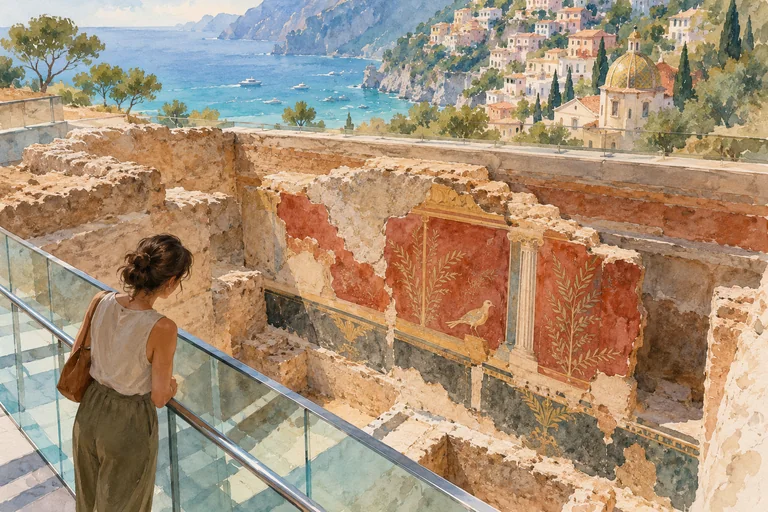
For now, these are subjects to explore through the institution’s records and images. They are not instructions for a self-guided interior walk. The illustration accompanying this article is an imagined conservation scene, not a depiction of the present worksite or a reconstruction of the villa.
Decide whether Minori itself still suits the day
Ask what would make the journey worthwhile without archaeological admission. Perhaps you want a measured town visit, a meal or a look at the coast from public spaces. The municipality’s territory page describes Minori’s citrus-growing and food traditions, but a general description does not guarantee a particular shop, demonstration or church is open on your date.
Choose one confirmed activity rather than replacing the closed villa with several unverified promises. If that leaves too little reason for the journey, postponing Minori is a sensible decision. A holiday does not improve merely because a familiar place name remains on the list.
Our Atrani guide offers another way of giving one coastal town a clear purpose. It is an alternative to evaluate, not an automatic addition to the same day. Each destination has its own transport and access questions.
Build the return journey before the outward one
From Sorrento, verify the actual route, any interchange and the final stop for Minori. Do not infer a direct ferry from a boat advertised to another Amalfi Coast town, and do not reuse a summer timetable for an autumn date. A promising outward departure is only half a plan.
Our road-or-sea comparison explains why the mode of travel should be chosen separately from the attraction. Allow a practical return margin and keep a simpler alternative available if weather or operating conditions change. Nothing in an archaeological history establishes that a ferry will run.
If an open archaeological interior is the priority, investigate the separate arrangements in our Positano Roman villa guide before substituting it. Check the current venue information again, since a different site’s admission cannot be assumed from this one’s closure.
The Amalfi Coast experience collection can help you compare actual stops, while Naples’ archaeological and city journal provides other possible interests for a longer trip. The useful outcome is a day whose central promise is true. Minori’s villa can remain a future interest without becoming a misleading present-tense booking suggestion.
Sources & further reading
Turn a good read into a great day.
Find a highly rated Sorrentine experience that brings these stories to life.
Explore related experiences →