Oplontis from Sorrento: how does a Roman villa differ from Pompeii’s streets?

After a day among Pompeii’s streets, another archaeological excursion can sound like more of the same. Oplontis offers a different scale of attention. At Villa A in Torre Annunziata, you can concentrate on the arrangement of a substantial residence: how rooms, openings and outdoor areas shape a sequence of encounters. From Sorrento, it works best as a deliberate visit to one place rather than an extra stop squeezed into an already crowded Pompeii day.
The distinction begins with geography. Oplontis is in the modern town of Torre Annunziata, not in Sorrento and not inside Pompeii’s excavated street network. A ticket, transport plan or meeting point for one should never be assumed to cover the other. Establish the destination clearly before choosing an itinerary.
Which villa can you visit?
The archaeological park distinguishes two complexes at Oplontis. Villa A is the richly decorated residence commonly called the Villa of Poppaea. Villa B is associated with agricultural and commercial activity, including wine and oil; the park currently describes it as unavailable for ordinary public visits. Plan around Villa A, rather than expecting a two-villa circuit.
The familiar name needs a small qualification. The park presents a possible association with Poppaea Sabina or her family, not a securely documented household biography for every room. Calling the site “Poppaea’s villa” is convenient shorthand; imagining a named person performing particular activities in a particular space goes beyond what that name proves.
For the larger urban experience, see our guide to planning Pompeii from Sorrento. The choice is not a competition over which site contains more. It is a decision about the kind of day and the kind of attention you want.
Read a threshold before a whole plan
A useful way to begin is to stand where the visitor route permits and look through one opening towards the next. Notice how much is visible immediately and what remains concealed. Then move and observe how the view changes. You are studying the surviving arrangement, without needing to invent the precise intentions of an ancient owner.
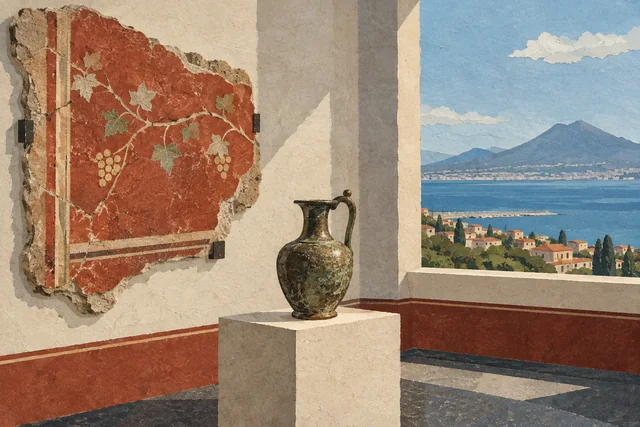
Wall painting can affect that experience by suggesting depth, framing an opening or giving visual rhythm to a room. Look for the difference between painted space and an actual passage. A photograph that crops away the doorway may make the decoration seem like an independent picture; the room reminds you that it belonged to an environment through which people moved.
Allow incomplete areas to remain incomplete in your mind. A modern support, a repaired surface or an absent upper storey may be necessary to conserve or understand the site. It is better to ask how interpretation distinguishes surviving evidence from restoration than to treat every visible element as an untouched Roman feature.
A villa is more than a luxurious photograph
The park dates the origin of Villa A to the middle of the first century BC, with enlargement during the early imperial period, and describes its former relationship with the sea. Today’s surrounding town is a reminder that ancient and modern landscapes do not line up neatly. Avoid expecting a coastal garden experience simply because a historical description mentions a sea view.
Choose two or three spatial questions for the visit: how large and small rooms relate, how a long view is framed, and where decorated surfaces draw the eye. Labels and a well-informed guide can add the evidence needed to interpret those observations. A general story about Roman luxury should not replace attention to the particular spaces in front of you.
If you enjoy comparing excavated buildings with material displayed in a museum, the Stabian museum at Quisisana suggests another excursion for a separate day. Closer to your base, the Georges Vallet Museum provides a local archaeological perspective. If Naples is another chapter of your trip, our sibling guide to visiting its Archaeological Museum at a manageable pace can help you plan a museum day separately.
Check the winter timetable and the ticket name
The archaeological park’s current timetable places Oplontis on its winter schedule from 15 October to 15 March: opening at 09:00, last admission at 16:00 and closing at 17:00, with Tuesday closure. Recheck the official page for your actual date and any notices. Older municipal summaries may show a different seasonal changeover, so use the park’s current operational information.
Read ticket inclusions carefully. A Pompeii Express ticket is for the ancient city; it does not automatically admit you to Oplontis. Broader park combinations have their own validity and entry conditions, and a multi-day ticket does not remove an individual site’s closing day. Match the product to the place before paying.
The municipality identifies Torre Annunziata–Oplonti station on the Naples–Sorrento Circumvesuviana route as an arrival option. Check the operator’s current service and your train’s stops, then plan the walk to Via Sepolcri and the return journey. Leave breathing room for disruption, food and your own pace. Our Sorrento day-trip experiences are a starting point for comparing actual routes and inclusions, rather than a promise that every excursion visits Oplontis.
Sources & further reading
Turn a good read into a great day.
Find a highly rated Sorrentine experience that brings these stories to life.
Explore related experiences →