The Georges Vallet Museum near Sorrento: what can local archaeology add to your trip?

The Sorrento peninsula has a history that is easy to overlook when every day points toward a boat, a coastal view or Pompeii. The Georges Vallet Museum offers a different starting point: objects and evidence from the territory around you. It can help turn a familiar holiday landscape into a place with a much longer human story, without requiring another large archaeological excursion.
The museum is at Villa Fondi de Sangro in Piano di Sorrento, a separate town from Sorrento itself. Put that full place name into your transport plan. A hotel described as being on the Sorrento coast is not necessarily nearby, and an itinerary that simply says Sorrento may not include Piano. Our guide to getting around the peninsula helps keep those distinctions practical.
Begin with territory rather than famous names
The Ministry of Culture’s museum entry identifies Georges Vallet as an archaeologist closely associated with research in southern Italy and places the collection within Villa Fondi. The museum’s service charter describes its purpose as explaining the territory’s history from prehistory to the Roman period. That local focus is the key to a rewarding visit.
Specific finds make that focus tangible. The Ministry describes a floor mosaic from a maritime villa near Punta della Calcarella at Marina di Puolo, and a mosaic-decorated nymphaeum from Marina della Lobra in Massa Lubrense. The latter, dated to the first century AD, includes blue and green decoration evoking underwater life and a garden with birds. Different coastal findspots become parts of a regional story about elite Roman seaside residences.
Read a label in three stages
The collection is not confined to Roman villas. The official entry also describes prehistoric arrowheads and other material from Trinità in Piano di Sorrento, alongside finds from the sanctuary of Athena at Punta Campanella. These examples help separate settlement, religious activity and later residential luxury rather than blending them into one vague ancient past. Start each label with material, date and findspot; then consider what kind of human activity the evidence supports.
Our article on reading the Roman coast at Regina Giovanna uses the same distinction between visible evidence and interpretation. A museum object and an outdoor ruin give you different kinds of information. Neither needs to supply a complete story on its own. The interesting work begins when you ask what is known, what is inferred and what remains unresolved.
Give the villa a place in the visit
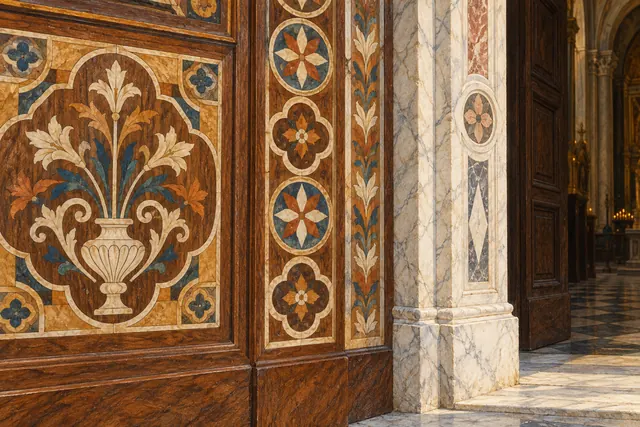
The municipality describes Villa Fondi as a neoclassical building constructed in 1840, set in a park above the Gulf of Naples. The villa is therefore another historical layer around the archaeological collection. Notice the difference between the age of a displayed object and the age of the room that now contains it. A museum is a present setting for material from many earlier settings.
If the relevant outdoor areas are open during your visit, use a short pause to reconnect the objects with the wider coastline. Do not assume every park path or room is accessible simply because the site is listed as open. Current routes, temporary closures and the needs of your party deserve a check before arrival. A historic building and its grounds can pose different practical questions from a modern exhibition hall.
Choose a small, satisfying goal
For children, one useful challenge is to find an object whose purpose is easy to guess and another that needs its label. Discuss why the second is harder. Adults can do the same without embarrassment. Archaeological interpretation is not a contest in instantly recognizing things. A carefully noticed cup or architectural fragment can stay in the memory longer than a fast march past an entire room.
For another collection on the peninsula, read our guide to the Museo Correale; it offers a different selection and setting, so choose according to your interests. Travelers continuing to Naples can compare the local approach with Naples Tour Hub’s archaeological museum planning guide. Bigger is not automatically better for every day.
Check the official museum page for current opening times, admissions and notices before setting out. Browse Sorrento cultural experiences if you want a guided element, verifying that the actual itinerary includes this museum before booking. Leave room afterward to discuss one object and one new place name. That modest goal is enough to make the peninsula feel less like a backdrop and more like a lived landscape.
Sources & further reading
Turn a good read into a great day.
Find a highly rated Sorrentine experience that brings these stories to life.
Explore related experiences →