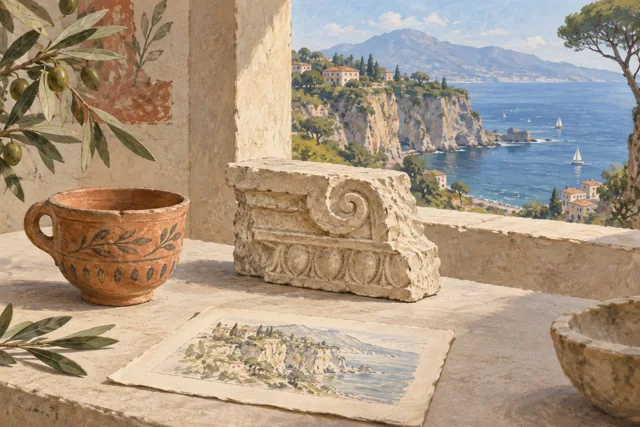
Regina Giovanna in Sorrento: how do you read the Roman coast?

The Bagni della Regina Giovanna are often reduced to a photograph of green-blue water. A visit can be more interesting when you look at the coast as an archaeological landscape. On Capo di Sorrento, the sea, surviving masonry and shape of the headland invite questions about how people have occupied this edge between land and water.
Start by separating two stories. Italy’s official tourism portal describes Roman villa remains associated with Pollio Felice and also recounts the much later legend linking the pool with Queen Giovanna II. The remains and the romantic tale are different kinds of evidence. Enjoy the story as a story without using it to explain every stone you see.
Ask why someone built here
The first question is geographical. What does the promontory offer that a house farther inland would not? Consider views, access to the sea and the effect of moving between enclosed rooms and open space. You do not have to reconstruct the whole villa in your imagination. In fact, resisting that temptation often makes the surviving evidence easier to appreciate.
The national tourism account places the villa in the first century AD and describes surviving vaulted rooms, former terraces and connections toward the water. Use those details as a starting point, then distinguish what you can actually identify from what the written explanation supplies. A broken wall may be evocative without revealing its original function to an untrained visitor.
Look at the ruins without climbing over them
Choose an allowed viewpoint and notice how masonry meets the natural rock. Look for changes in level and for the way fragments frame the sea. These simple observations turn the visit from a search for the most dramatic photograph into a study of place. Stay on permitted routes and leave the fabric of the site untouched; an ancient wall is not a viewing platform just because somebody else has stood on it.
If archaeology is a particular interest, compare this experience with a more fully interpreted site on another day. Our guide to planning Pompeii from Sorrento explains the practical commitment involved. Over in Naples, the article on reading Herculaneum’s house layouts offers a useful contrast between a coastal villa landscape and surviving urban domestic spaces.
Treat the approach as part of the outing
Do not plan from a social-media clip that begins at the water’s edge. Check the route from your accommodation, the final pedestrian approach and the return journey. Conditions underfoot matter more than a straight-line distance. Allow extra time if your group moves slowly, wants frequent stops or is unfamiliar with uneven coastal paths.
Our guide to transport details in Sorrento is a useful companion when comparing ways to reach the area. Confirm current services and stops directly before travel, and check local notices through the municipality where relevant. If an access restriction is in force, change the plan rather than treating an old photograph as permission to continue.
Make the visit worthwhile without promising a swim
A coastal visit should still feel successful if you remain on land. Sea conditions, local restrictions, your swimming ability and the practical route to the water all affect that decision. A sheltered-looking photograph does not establish conditions on your day. Follow current signs and local guidance; never jump into water whose depth and hazards you do not know.
Pack for a walk first: suitable footwear, drinking water and protection appropriate to the weather. Keep the return in mind when deciding how much energy to spend exploring. For a group with differing mobility needs, consult our guide to planning Sorrento around accessibility and ask specific questions about the actual route. Choosing a more suitable viewpoint is a sensible change, not a failed visit.
Keep the rest of the day simple
After the coast, an easy meal or a short old-town stroll can provide a good change of pace. Avoid attaching a tightly timed departure immediately afterward. A plan with breathing room lets you respond to weather and energy levels, and it prevents a beautiful headland from becoming another obstacle between appointments.
Browse Sorrento walking experiences if you would like interpretation or a different guided route. Read the listed itinerary carefully: a town walk does not automatically include Capo di Sorrento, archaeological access or swimming. Whether you go independently or with a guide, the most rewarding question is larger than the pool: how has this particular meeting of rock, sea and human ambition shaped the coast?
Sources & further reading
Turn a good read into a great day.
Find a highly rated Sorrentine experience that brings these stories to life.
Explore related experiences →