Sant’Agnello’s Marinella viewpoint: how do you plan a short walk around slopes and return routes?

A short walk to Marinella becomes easier to plan when you decide what you mean by “the coast.” The upper viewpoint, a route down towards the sea and the journey back to your accommodation are three separate parts of an outing. You can enjoy the first without committing to the second. That distinction is especially useful in November, when an assumption carried over from the summer lift season can change the amount of climbing involved. Agree on the intended endpoint before leaving, so nobody feels committed to a descent they had understood as an optional extra.
Name the upper viewpoint first
The Comune di Sant’Agnello’s place page identifies the belvedere associated with Marinella and Cappuccini on Via Cappuccini. Use that upper viewpoint as the destination when planning an easy-looking pause above the water. A map result for a beach establishment or an access stair may lead you to a different part of the same coastal edge.
Our guide to Sant’Agnello as a separate town helps establish the wider setting. Decide whether you are starting within Sant’Agnello or travelling from Sorrento, then examine the actual route from that starting point. A modest distance on a map does not describe pavement width, crossings, slopes or the effort required by every member of your group.
Treat the lift and the descent as separate services
The published Marinella beach-access information, checked for this article on 2 November 2026, lists the lift season from 1 April through 31 October. It separately lists a winter timetable for the public pedestrian descent. November falls outside the stated lift season: do not plan a beach descent on the assumption that an operating lift will bring you back up.
Confirm any current exception directly with the access operator before relying on it. A published pedestrian opening period does not establish that the route suits your mobility needs or that conditions will remain unchanged after bad weather. If the return would depend on mechanical access, keep your outing at the upper level until you have a definite answer. The viewpoint can be the whole purpose of the walk.
Build the return into the decision to continue
Before leaving the upper area, ask whether everyone is comfortable completing the reverse journey without a lift. Count the descent as the beginning of the effort rather than the end of the walk. A companion may find going down manageable and coming back up much harder. It is easier to agree on a comfortable stopping point while the group still has a choice.
Carry only what you are happy to bring back along the same route. Avoid treating a sea-level destination as a casual extra between two fixed appointments. Give yourself time to turn around, rest and change plans if the path, weather or posted instructions differ from expectations. Follow barriers and current signs; an attractive glimpse of the shore is not a reason to continue beyond an open public route.
Give a short stop its own subject
From a permitted upper position, choose something simple to observe: the relationship between the cliff edge and the built streets, the changing colour of distant land, or the way a terrace creates a pause within a town. You do not need a long checklist of named landmarks. In hazy conditions, it can be more satisfying to notice the near layers clearly than to insist on identifying a distant outline.
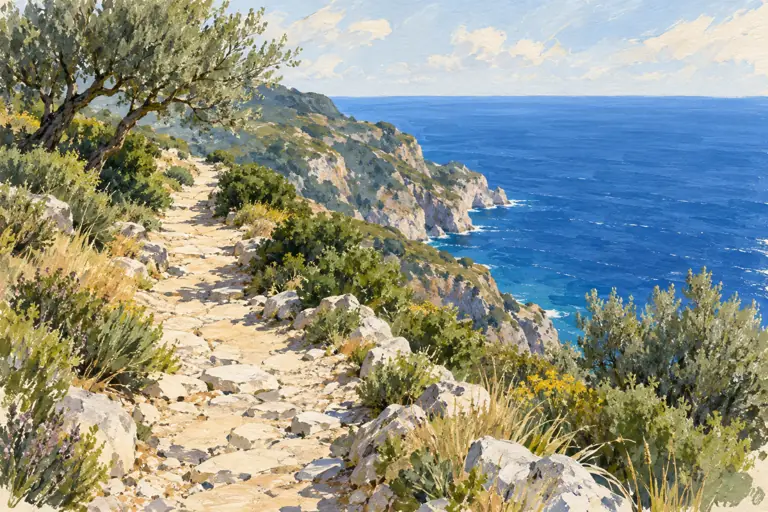
Leave space along the parapet for others and avoid occupying the full width of a path while taking photographs. An illustration or older photograph cannot show the exact conditions you will find. The artwork with this article is an imagined coastal composition, not a route diagram. Use current local information and what you can actually see to decide where it is appropriate to walk.
Choose a second stop that keeps the outing manageable
If you want another Sant’Agnello subject, read about Oasi in Città before deciding whether its separate location and current access fit the day. Two green or open-air places do not necessarily form one effortless route. Check the connecting streets and be willing to enjoy just one when time or energy is limited.
The same naming discipline helps at Sorrento’s own waterfront: Marina Grande and Marina Piccola are different destinations. A plan that says only “walk down to the sea” can conceal the most consequential part of the outing. Write down the actual endpoint and the return option before setting off.
Browse the Sorrento walking collection if you would like a separately described guided route, checking its terrain and meeting point. For another public-space comparison across the bay, our sister site’s Villa Comunale guide focuses on how a promenade can be a destination in itself. At Marinella, a satisfying short walk is the one whose return you have understood as carefully as its view.
Sources & further reading
Turn a good read into a great day.
Find a highly rated Sorrentine experience that brings these stories to life.
Explore related experiences →