What do Sorrento’s old walls tell you about the town?
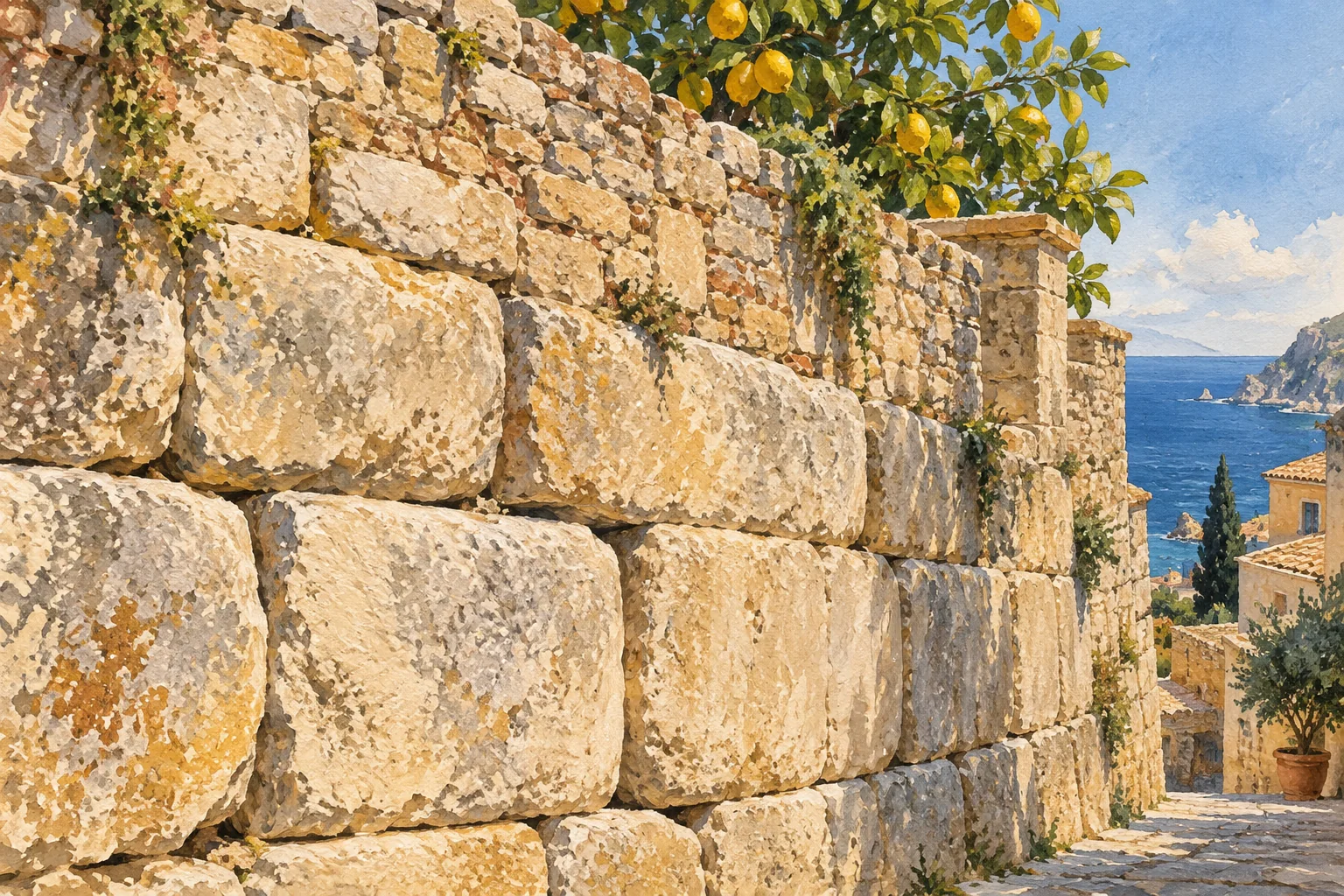
Sorrento’s walls offer a different starting point from its sea views. They ask you to imagine a town with controlled entrances, exposed boundaries and changing ideas about defense. The remains do not form one untouched monument from a single century. Their interest lies in the way older structures, later fortifications and the modern town meet.
Begin with our guide to reading the old town, then choose a small section of the boundary to investigate. You do not need to trace every surviving fragment. A wall, a gate and the street leading toward them can provide enough material for a satisfying walk.
Read a boundary before assigning a date
First consider what the wall separates. Is the ground level the same on both sides? Does the street run beside it or cut through it? Can you see how a doorway changes the movement of people? These questions are easier to answer by looking than an exact construction date, and they help you understand what a fortification actually did.
Keep visible observations distinct from historical identifications. Large blocks are not automatically ancient, and a neat joint is not necessarily modern. Repair can preserve a wall while changing its surface. If a panel identifies an earlier foundation beneath a later defense, record those as different phases instead of choosing whichever period sounds most impressive.
Understand the Parsano area as a layered site
The municipality’s announcement of the restored wall walk identifies the connection between Bastione Parsano and Bastione San Valerio. It documents a specific restoration and opening, rather than proving that every section is continuously available on every future date. Check current access locally before building your day around walking on top of the defenses.
The city also includes the ancient viceregal walls and Parsano bastion in its cultural planning document. That modern attention is part of the story: surviving fortifications require management, maintenance and decisions about how visitors encounter them. A protected historic site is not a frozen object.
A gate makes history easier to imagine
The national tourism portal’s account of Marina Grande describes the old double-arched gate on the way to the fishing quarter and its squared-stone construction. The important visitor’s distinction is between a gateway’s long history and the alterations through which it survives. Do not expect every visible surface to belong to the earliest phase described.
Think about what passing through a restricted opening would mean for goods, workers and residents. A gate concentrates movement that an open modern street allows to spread. Look back after passing through, if the route is appropriate for you, and compare the two views. The change in framing can make an otherwise familiar lane feel quite different.
Separate a historical walk from a harbor transfer
If you continue toward the water, check which harbor your plans require. Our explanation of Marina Grande and Marina Piccola prevents a common misunderstanding: a scenic fishing-quarter visit and a scheduled ferry departure are different tasks. A historical detour should not consume the margin you need to meet a boat.
Slopes, stairs and uneven surfaces also matter more than the distance looks on a map. Use our mobility planning questions before choosing a descent. It is perfectly reasonable to study the walls from an accessible public viewpoint and leave the harbor for another outing. The historical subject remains worthwhile without completing a prescribed circuit.
Give the remains a place in an ordinary town day
A good sequence might be a short look at the walls, a quiet old-town lane and one interior visit chosen for your interests. Keep room for a drink, a meal and a change of weather. If traveling with children, invite them to identify an opening, a change in stonework and a place where the modern town interrupts the old boundary. Looking for three things is more engaging than listening to a long list of rulers.
Compare our Sorrento walking experiences if you would like a guide, verifying that the relevant walls or gates appear in the actual itinerary. Ask whether admission to a wall walk is included or whether the visit is from street level. Before leaving, take one wide view and one detail, where photography is permitted. Together they will remind you both where the wall stood and what made you stop to look.
Sources & further reading
Turn a good read into a great day.
Find a highly rated Sorrentine experience that brings these stories to life.
Explore related experiences →