Annunziata near Massa Lubrense: what can a small hilltop hamlet add to a Sorrento stay?

Annunziata offers a small-scale excursion from Sorrento: a hilltop hamlet in the municipality of Massa Lubrense, where a church square, old houses and a sea-facing viewpoint can give shape to an unhurried visit. It works particularly well if you enjoy asking how a modest place acquired a larger historical role. It works less well if you arrive expecting a castle attraction with guaranteed daily entry.
The distinction is practical as well as historical. The local Pro Loco’s Italian visitor page says the surviving castle tower can be visited on the occasion of events and other organised activities. Plan the hamlet as the main destination; treat tower access as something to confirm for a specific event, not the automatic reward at the top of a walk.
Put Annunziata in the right municipality
Sorrento is your possible base, not the name of every settlement on the peninsula. Annunziata belongs to Massa Lubrense. The local tourism office places it at roughly 200 metres above sea level and describes lanes, stairways and houses with vaulted roofs. That combination explains why a short distance on a map can involve a more substantial change of level on foot.
It also suggests what to look for. Notice how entrances meet sloping ground, how a lane turns into steps and how a glimpse of the sea appears between buildings. These are ordinary parts of a lived settlement. Keep doorways clear and avoid treating residential passages as public viewing platforms merely because they would improve a photograph.
Read the church without calling everything medieval
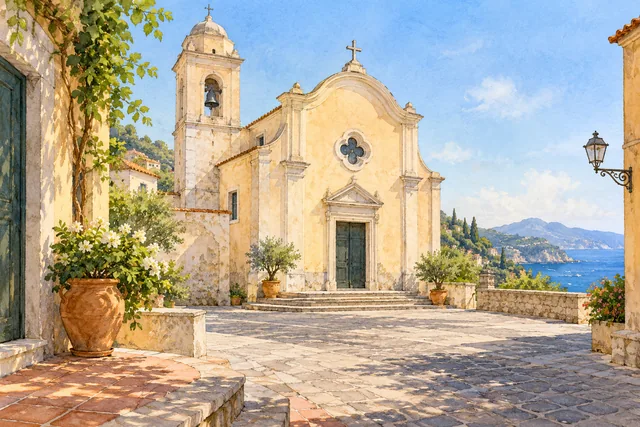
The Pro Loco’s church account is careful about the building’s uncertain origins. It describes later rebuilding and identifies an inscription dated 1749 associated with a decorative renewal led by the abbess Maria Cristina Romano. The current appearance therefore cannot simply be labelled medieval because the hamlet has medieval history.
If the church is open outside services, look at the relationship between its single nave, side chapels and decorative surfaces. The local account describes white stucco, naturalistic details and cherub heads. Those give you a few concrete things to find without turning the visit into a test of artistic attribution. Respect worship and ask about photography where guidance is unclear; opening of the square does not imply opening of the church.
For the wider story of changing religious centres, our guide to Massa Lubrense’s former cathedral supplies a useful companion. Keep the two buildings distinct even when their histories connect.
Distinguish a surviving tower from a complete castle
The official local history of the castle describes a cylindrical tower and part of the defensive wall as the surviving remains. Its account follows successive construction, destruction and reuse. That is a very different proposition from a furnished castle interior or a complete ring of medieval fortifications.
A fragment can still be informative. Ask why a defended site occupied this high ground and how the settlement relates to it. Look from lawful public viewpoints, using the visible remains to think about position rather than imagining an exact lost skyline. If an event opens the tower, ask about stairs, capacity and the permitted route before booking or travelling.
Allow the viewpoint to be enough
The hamlet’s belvedere is described by the tourism office as a garden viewpoint with benches and a view towards Capri. Visibility is a matter of conditions, however, not a promise attached to the destination. On a hazy day, the nearby rooflines and the changing light over the water can still hold your attention.
You can compare this elevated perspective with the shore-level setting of Marina della Lobra, but do not assume that combining them means an effortless stroll. A route joining hill and harbour needs its own assessment of ascent, descent, road sections and the return journey. Choose one complete visit if that suits your energy better.
Check the last part of the journey
The Pro Loco identifies the S. Maria–Annunziata junction as a bus stop for reaching the area. A junction stop is not a promise of being dropped in the church square. Check the current service, the onward walk and the return stop, particularly on Sundays and holidays. Our Sorrento transport guide explains why the final connection deserves as much attention as the main journey.
For a private transfer, agree the exact meeting and collection points. For walking, use a current local route and consider surface, gradients and daylight; a scenic description is not a substitute for those details. Confirm step-free arrangements directly if needed rather than inferring them from a short listed distance.
Choose the pace that makes the hamlet meaningful
Our piece on visiting Termini as a village offers a similar planning idea: a small settlement need not justify itself by leading somewhere else. If you prefer an organised excursion, compare the actual departure points and stops in the Sorrento day-trip collection; Annunziata is included only when the itinerary says so.
A good Annunziata visit might consist of the square, a careful look at the church exterior and time at the viewpoint. Add an interior or tower event when it is genuinely available. The pleasure lies in understanding this particular place, not in completing a list of doors you hoped would open.
Sources & further reading
Turn a good read into a great day.
Find a highly rated Sorrentine experience that brings these stories to life.
Explore related experiences →