Sorrento’s Vallone dei Mulini: how do you read a landscape from above?

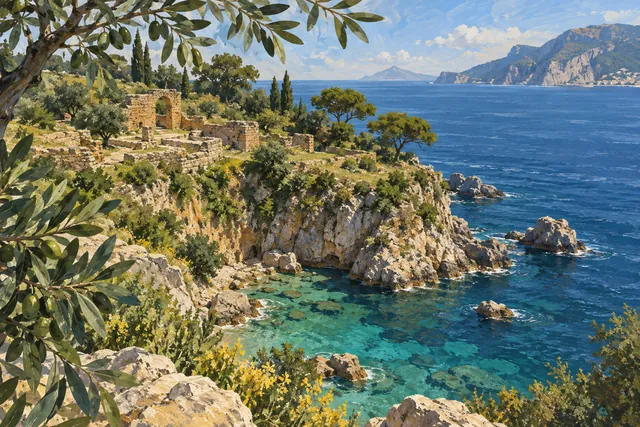
Sorrento’s Vallone dei Mulini can look like a place that nature has simply taken back. Greenery softens old masonry, the ravine drops away from the town, and a photograph easily turns the scene into a timeless ruin. Yet the view becomes more interesting when you ask what people built, altered and later stopped using. This is a landscape with an industrial and urban history, not only an attractive pocket of foliage.
Plan to observe it from permitted public viewpoints above. A glimpse of structures below is not an invitation to descend, and this article does not describe an access route into the ravine. Respect barriers and current local notices. The contrast between the busy town and the space beneath it is something you can study without entering the remains.
Notice the shape before the building
The Municipality of Sorrento’s account of the historic centre explains the importance of natural valleys around the town’s landward sides and the surviving portion associated with the old mills. Look at the steepness of the sides and the relationship between the depression and the streets above. This topography helps explain why the ravine mattered before its modern life as a much-photographed view.
Our guide to Sorrento’s old walls offers a useful companion to that observation. Defences, routes and natural landforms belong in the same conversation. Avoid assuming, however, that every visible edge corresponds to an ancient boundary. The town has changed repeatedly, and an attractive continuous outline can conceal several periods of intervention.
Replace the single abandonment story with a sequence
The virtual exhibition created by the Naples committee of the Istituto per la storia del Risorgimento italiano brings together documentary material about the valley. Its industrial-history section describes nineteenth-century investment, including the reconstruction of a mill and the use of steam power. The setting was not simply a medieval mechanism left untouched until vegetation arrived.
The exhibition’s account of abandonment also describes steam-powered milling continuing into the early twentieth century, alongside major changes in the surrounding town. That makes a neat, single-date story of total abandonment unhelpful. Different structures and activities need not have stopped together. When reading a caption elsewhere, ask whether its date concerns a road, a particular machine, a building or the valley as a whole.
Read a photograph as a dated view
Historical photographs and postcards can help you notice changes in roofs, openings and vegetation. They also have limits. A camera records a chosen angle at a particular moment; it does not show every activity taking place beyond the frame. If you compare an older view with today’s permitted viewpoint, start with features that are clearly identifiable in both. Do not force a match where the angle or surviving fabric makes it uncertain.
The same discipline works in Sorrento’s streets. Our guide to reading the old town beyond its shop windows encourages attention to building edges and changing uses. A town can preserve a recognizable form while the work carried on inside it changes dramatically. At the ravine, that relationship between appearance and activity is especially striking.
Separate greenery from chronology as well. The amount of foliage in a view cannot by itself date a building or tell you when its last occupants left. Nor does an exposed wall automatically represent the earliest structure on the site. A useful notebook can have two columns: visible observations on one side, documented dates and uses on the other. The gap between them gives you a precise question to pursue later, instead of a romantic explanation that merely sounds convincing.
Give the stop a sensible place in your day
Treat the viewpoint as one part of a town walk, not a substitute for a booked attraction or a guaranteed long visit. Your view may be affected by works, access arrangements or vegetation. Leave the pavement clear for other people, keep belongings secure and avoid leaning beyond protective boundaries for photographs. A quiet few minutes with a well-chosen question can be more rewarding than trying to capture every visible corner.
For the broader day, use our first-day Sorrento guide and compare local walking experiences for their actual routes. If the industrial aspect catches your imagination and Naples is also on your itinerary, Pietrarsa’s railway museum offers a different, separately planned encounter with machines and working history. The valley’s appeal need not depend on mystery: knowing that people repeatedly reshaped it makes the surviving view richer.
Sources & further reading
Turn a good read into a great day.
Find a highly rated Sorrentine experience that brings these stories to life.
Explore related experiences →