Path of the Gods from Sorrento: how do you plan Bomerano, Nocelle and the return?

The Path of the Gods can be a rewarding excursion during a Sorrento stay, provided you plan the journey around the walk’s actual endpoints. For the Bomerano-to-Nocelle route, Sorrento is your base, not the trailhead. The day has three separate parts: reaching Bomerano, walking the mountain path, and getting home from Nocelle. Solving the last part before you leave makes the middle part much easier to enjoy.
Where does the walk start and finish?
The CAI Monti Lattari description of trail 327 connects Bomerano, in Agerola, with Nocelle, above Positano. It lists 5.3 kilometres, a two-hour walking estimate and cumulative ascent and descent of 184 and 356 metres respectively. Those figures describe the trail, not a complete day from Sorrento. Transfers, pauses and any descent beyond Nocelle require additional time.
Write “Bomerano” and “Nocelle” into your itinerary rather than using only the broad place names Agerola and Positano. A transport booking to one part of a municipality does not necessarily deliver you to the point you intended. For a guided trip, ask for the precise meeting place, walking endpoint and pickup arrangement. For an independent outing, establish each connection and what you will do if one is missed.
Our guide to getting to and around Sorrento helps frame those transport questions. Compare the entire chain of journeys, including the final return, before deciding whether a transfer, public transport or an organized excursion best fits your day.
Does the terrain suit everyone in your group?
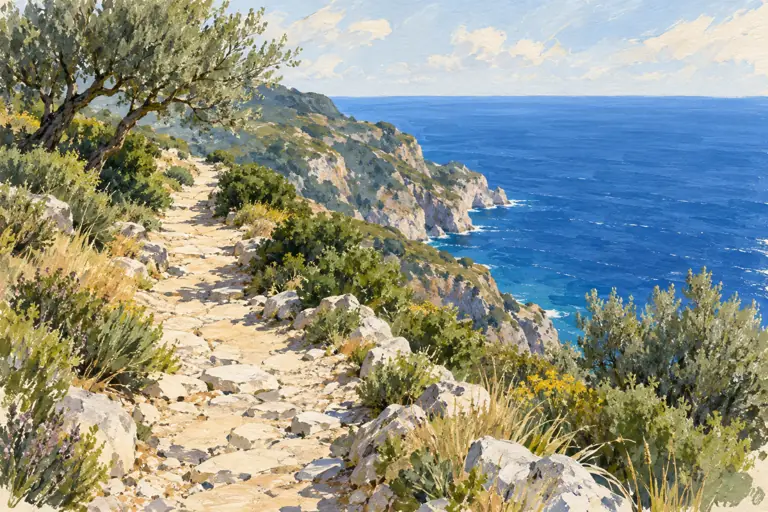
A relatively short distance does not make this an urban stroll. CAI describes a fork at Colle La Serra: the left-hand route is more exposed, while the right-hand 327a alternative is less exposed; they meet again farther on. The Municipality of Agerola’s route description also notes uneven ground on the upper option. “Less exposed” should not be read as a promise of an easy or step-free path.
Discuss uneven footing, heights and a sustained walk before booking. The relevant question is how each person feels on mountain paths, rather than how many kilometres they can cover on a pavement. If somebody is uncertain, a guide can help assess the proposed outing, but a guide does not remove the physical terrain. Ask about group pace, the route actually used and the arrangements if someone cannot continue.
Choose footwear appropriate to uneven ground and carry what your group needs for the day, including water and sun protection. Check local notices and the forecast close to departure, and follow any closures or instructions on the ground. A saved route description is useful preparation; it is not evidence that conditions are suitable on your chosen morning. Our Ieranto Bay walking guide offers a different excursion to assess on its own terms, with its own terrain and return climb.
What happens when you reach Nocelle?
Treat arriving in Nocelle as the end of the planned mountain section. It is not the same as arriving at a boat departure point in Positano. CAI identifies onward local bus travel and further walking as separate possibilities. Confirm the current service and boarding point if you intend to take a bus; if you intend to continue on foot, study that additional route as carefully as the main walk.
Do not casually add a large stair descent because it appears to be “on the way.” Agerola’s description includes an option down approximately 1,700 steps to Arienzo, followed by a section beside road traffic. That is a substantial addition to the outing, with a different set of demands. Decide beforehand whether it belongs in your plan, rather than making it the default answer when everyone is already tired.
The same discipline applies to returning by sea. Our Amalfi Coast road-or-sea guide helps compare the choices, but your actual sailing must be checked for the date, operator and departure port. Leave a generous margin between finishing the walk and any fixed onward departure, and identify a workable alternative if the intended connection is unavailable.
What deserves your attention along the way?
The distant coast is only one layer of the landscape. Agerola’s account draws attention to cultivated terraces, dry-stone retaining walls and rural buildings. Where you can stop safely without obstructing the path, look at how those structures respond to the slope. A wall supporting a narrow strip of ground gives a very different sense of scale from the broad view across the sea.
Let those details set a slower rhythm. You do not need to reach every viewpoint or produce an uninterrupted record of the walk. Pause in suitable places, keep attention on your footing while moving, and leave room in the schedule for the group’s natural pace. The published walking estimate is a reference for planning, not a target to beat.
How do you keep the day flexible?
Book the excursion only when the route and transport arrangement make sense together. Our walking experiences collection can help you compare options; check each listing’s meeting point and inclusions. If your wider trip also includes Naples, the guide to walking on Vesuvius shows why another mountain outing needs its own preparation. Finally, keep a separate rainy-day plan in Sorrento. Moving the hike to a suitable day can preserve the pleasure of the walk as well as the practical shape of your stay.
Sources & further reading
Turn a good read into a great day.
Find a highly rated Sorrentine experience that brings these stories to life.
Explore related experiences →