Praiano’s San Gennaro from Sorrento: how do tiles connect a church with its town?

San Gennaro in Praiano offers a rewarding reason to look beyond a coastal panorama. Its tiled surfaces connect architecture, craft and the life of a parish, but they also pose a surprisingly useful question: are you looking at an old material, an old design, or a later version of both? From a Sorrento base, make this a deliberately planned excursion to Vettica Maggiore in Praiano. It is not a church in Sorrento, and a route that merely passes through the Amalfi Coast does not necessarily stop here.
Start with the right place
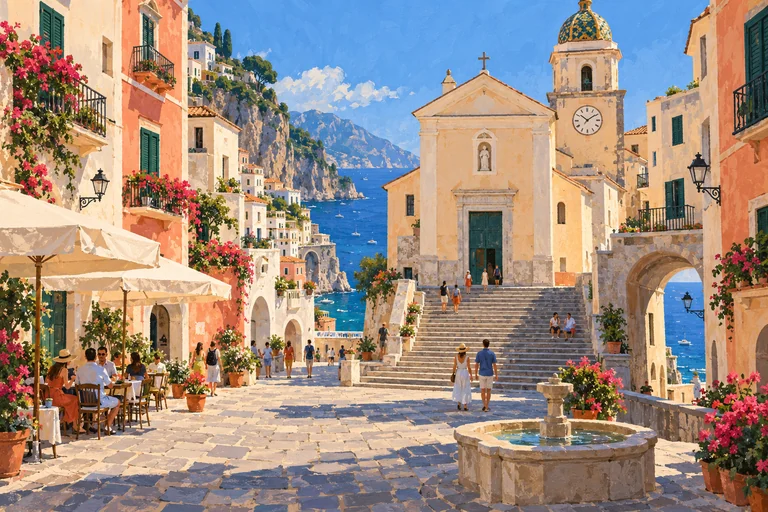
The municipality identifies San Gennaro as the parish church of Vettica Maggiore. Its account describes a building with three aisles and a colourful majolica-covered dome, begun in 1589 on the site of an earlier church. That municipal history gives a more reliable starting point than a photograph caption that labels every coastal dome “Amalfi”. Keep the precise place name in your travel notes, along with the entrance and the return stop you intend to use.
Before booking transport, separate three questions: how you reach Praiano, how you reach the church from your arrival point, and how you return to Sorrento. A place can look close on a coastal map while involving a less direct journey on the ground. Check current services and walking conditions for your particular date. Our road-or-sea planning guide helps compare the kind of day each approach creates without assuming that a boat reaches every neighbourhood.
Distinguish a pattern from the material carrying it
The UNESCO Amalfi Coast management site makes a particularly helpful distinction about the interior floor: it dates the earlier pavement to 1771 and records its replacement by a copy in 1966. It also dates the present façade to 1931. Those details prevent an attractive but misleading reading of the church as a single unchanged object. A later surface can preserve or reinterpret an older design while having its own history of making and maintenance.
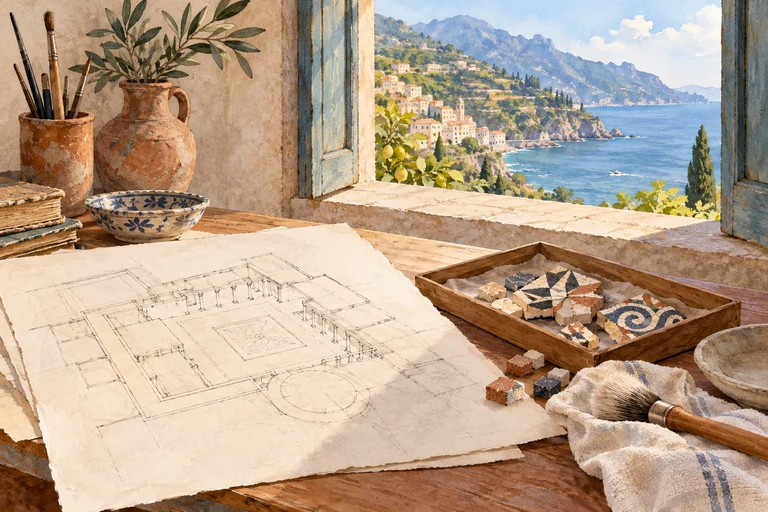
If the church is open for a suitable visit, look first at how a pattern occupies the room. Does it guide the eye towards an altar, repeat at regular intervals or mark a boundary? Then compare that overall arrangement with one small area you can see from an authorised position. You do not need to touch the floor, move furniture or enter a restricted space to make the comparison. An observation from the ordinary visitor route is enough.
This also changes how you read photographs. A close-up may reveal colour and joins while hiding the scale of the room; a distant view may show the arrangement but conceal repairs. Neither is the complete story. Try making one written note about the whole and another about a detail. If you cannot establish whether a particular tile belongs to a later intervention, leave that question open rather than inventing a date from its appearance.
Remember that a parish is more than its surfaces
The church’s religious use should shape the visit before the camera does. Check whether worship, a funeral or another parish activity is taking place, and accept that cultural visiting may need to wait. A broad municipal statement about public access is not a promise of continuous tourist opening. Quiet voices, suitable clothing and attention to local instructions allow the building to remain a shared place rather than a backdrop arranged for visitors.
If entry is unavailable, the excursion need not become a failure. From public space, you can consider how the square frames the building and how the dome relates to the surrounding settlement. Do not compensate for a closed door by trying side entrances or entering private terraces. A shorter exterior study, followed by time in the town, can be more satisfying than spending the afternoon trying to force a checklist into completion.
Compare ceramic encounters without flattening their differences
Our San Michele floor guide in Anacapri provides a useful comparison: it concerns another church, another island journey and a different visitor arrangement. It should not become an extra stop casually added to this mainland outing. Likewise, Vietri’s ceramic traditions invite a separate distinction between working shops, town decoration and museum collections.
For a wider cultural perspective, Italy Tour Hub’s guide to Italian ceramic traditions explains why regional materials deserve specific questions. A colourful surface alone does not identify the workshop, date or technique that produced it. Learning to ask about those differences is more useful than collecting a single label for everything blue and yellow along the coast.
When comparing Amalfi Coast experiences from the Sorrento area, read the actual itinerary, departure point and time allowed in each town. Do not infer church entry from a stop named Praiano. The strongest plan leaves enough room for one building, one careful observation and the journey back. San Gennaro then becomes a place you have considered, rather than another dome briefly photographed through a window.
Sources & further reading
Turn a good read into a great day.
Find a highly rated Sorrentine experience that brings these stories to life.
Explore related experiences →