What should you notice in Sorrento’s San Francesco cloister?
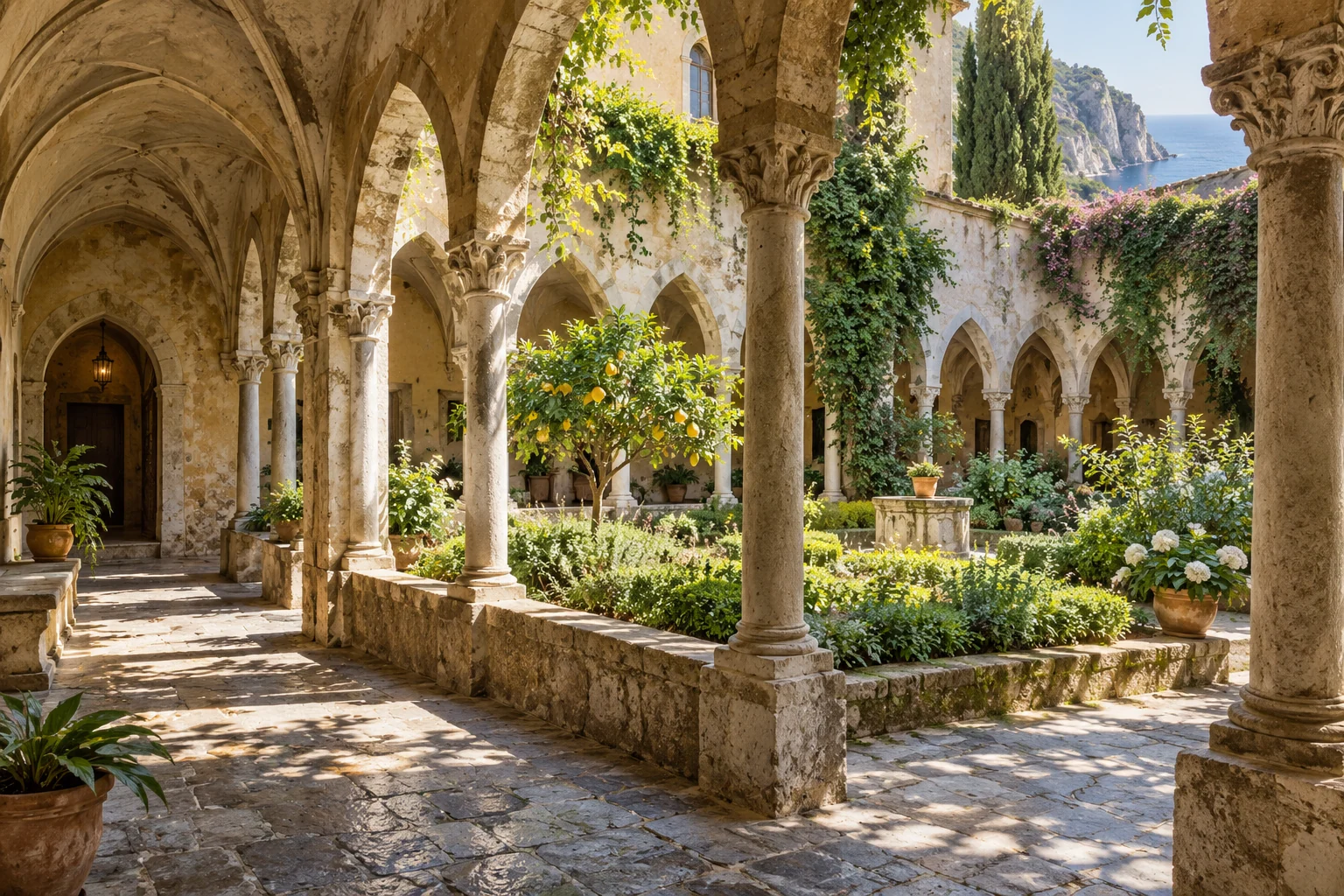
A cloister can be one of the most restorative stops in a busy town, but quietness is only part of its interest. At San Francesco in Sorrento, the pleasure lies in the relationship between a courtyard, the covered walk around it and the changing forms of the architecture. You can enjoy that relationship in a short visit if you look deliberately. Think of this as a small exercise in seeing, with no requirement to memorize a sequence of architectural terms.
Start with the whole space
Pause before moving toward the most photogenic corner. Notice the courtyard’s proportions, the covered edges and how light falls across the paving. A cloister organizes movement around an open center; that simple arrangement changes how you experience a building. You see across the space as well as along it, and the same feature can appear framed differently from several positions.
Choose a place where you are not obstructing anyone, then let your eyes adjust to the contrast between shade and sunlight. Avoid immediately reducing the visit to a single photograph. The atmosphere depends on the spaces between columns, the direction of the light and the relationship between the open and covered areas. Those things are easier to appreciate when you give them a few uninterrupted minutes.
Compare the arches rather than naming everything
The municipality’s historic-center account describes crossed arches on two sides and rounded arches on the others. Use that observation as an invitation to compare. Look at the shape of an opening, the point where it meets a support and the rhythm created by repetition. You do not need to decide which form is more beautiful; the difference itself is part of what makes the space interesting.
Move slowly enough to see how a column or pier changes your view of the next opening. If you are visiting with someone else, each choose one detail and explain why it caught your attention. This is a simple way to make a short cultural visit sociable without turning it into a lecture. Our old-town guide uses similar questions to connect buildings with the streets around them.
Keep the place’s current life in view
Historic religious spaces continue to have uses beyond tourism. Services, ceremonies, events or maintenance can affect access and the atmosphere of a visit. Follow the information and instructions you find on arrival, keep voices considerate and accept that some areas may not be available. A wedding or gathering is not a performance staged for passing visitors.
If photography is allowed, avoid blocking routes or lingering in someone else’s activity to obtain an empty frame. A photograph with ordinary life in it can be more honest than one that required treating everyone nearby as an inconvenience. The same principle applies throughout Sorrento: the town’s appeal comes partly from its continuing use, not from being preserved exclusively for visitors.
Pair a short visit with one nearby pleasure
The cloister works well as part of a compact town morning. You could combine it with a walk through the historic center, a café pause or another nearby cultural stop after checking opening arrangements. Do not assume that every adjacent attraction can be fitted into the same short interval. The value of a focused visit is that it leaves you attentive rather than hurried.
Our short-experience collection offers options for travelers with limited time, but duration should include your journey to the meeting point as well as the activity itself. If your next commitment is a ferry, keep a separate buffer for the descent to the correct harbor. A peaceful courtyard loses some of its restorative effect if you spend the entire visit watching the clock.
Leave with a question, not just a picture
Ask what the contrasting forms suggest about the life of the building. Different parts can record alteration, repair and changing preferences without fitting a simple story of one date and one designer. A reliable guide or the municipality’s account can provide context; your own role is to notice the evidence that makes the explanation meaningful. Resist filling every gap with a confident guess.
Afterward, a garden or sea-view pause can let the visual memory settle. Our first-day itinerary leaves room for precisely that kind of transition. You may remember a curve of stone, a patch of light or the way an opening framed the opposite side of the courtyard. That is enough. A short visit becomes substantial when you have genuinely looked, and the San Francesco cloister offers a graceful place to practice.
Sources & further reading
Turn a good read into a great day.
Find a highly rated Sorrentine experience that brings these stories to life.
Explore related experiences →