Amalfi’s Arsenale from Sorrento: how do you plan a maritime-history visit in winter?

Amalfi’s Arsenale can give a coastal excursion a clear historical focus: a building associated with making and repairing ships, now housing the Museo della Bussola e del Ducato Marinaro. From Sorrento, the useful first decision is whether you can give that visit enough time within the day’s transport arrangements. In winter, the admission window becomes more important than the temptation to combine several towns. Plan the journey around one confirmed purpose, with a workable return.
Use the winter hours that begin in November
The official Visit Amalfi page lists the Arsenale’s 3 November–31 March schedule as 10:00–16:40, with last admission at 16:10. It gives a separate 26 December–6 January holiday window ending at 19:00, with last admission at 18:30. These details were checked on 3 November 2026. Confirm the date-specific arrangements before leaving Sorrento, including any event affecting the museum route.
The last-entry time is a boundary, not a recommended arrival target. Allow room for finding the entrance, checking admission and looking without having to leave immediately. Our guide to travelling from Sorrento to the Amalfi Coast by road or sea explains why the journey itself needs a separate decision. This article does not establish a current ferry service or a guaranteed connection; check the operator’s actual seasonal timetable and conditions.
Begin with the building’s working purpose
The municipal Arsenale website places documentary evidence for the building in 1042 and identifies its current museum and cultural uses. Visit Amalfi describes shipbuilding and repair, particularly of galleys, and the surviving arrangement of pointed arches, vaults and stone supports. Start by considering what a working hall needed to accommodate: materials, movement and objects much larger than the tools used to make them.
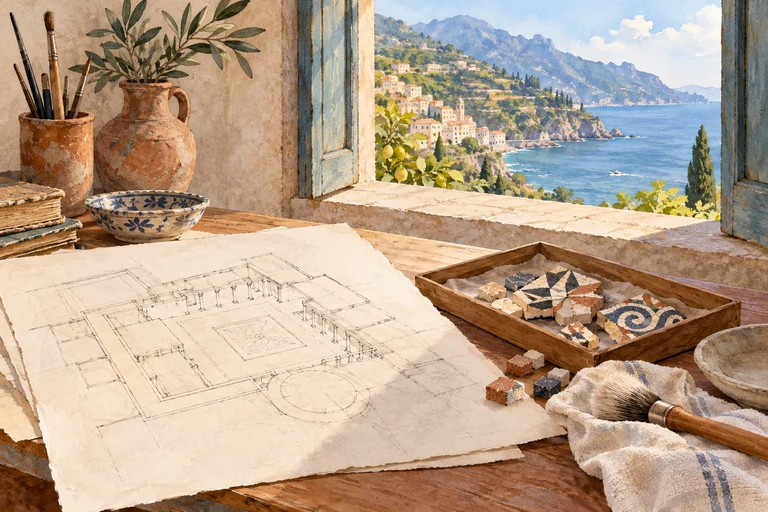
You do not need to reconstruct a complete medieval working day to ask a useful question. Look at the relationship between the length of the space and its repeated supports. Consider how an architectural description differs from a scene showing workers at their tasks. The illustration on this page is an imagined coastal workshop, not a measured view of the Arsenale or evidence of a particular historical construction method.
Separate the age of the hall from the age of its displays
An old building can contain objects made at many different times. Visit Amalfi identifies the wooden vessel displayed after restoration in 2022 with the city’s participation in the modern Regatta of the Ancient Maritime Republics. It also describes a model presenting an interpretation of medieval Amalfi. Neither should be mistaken for an untouched medieval ship or an eyewitness record simply because it stands inside an ancient structure.
Read the labels for the distinction between original, copy, model and later commemorative object. Then ask what each contributes. A model can clarify spatial relationships; a later vessel can reveal how a community represents its maritime past; a document can preserve a particular rule or transaction. Their evidential value comes from identifying what they are, not from expecting every display to be equally old.
Ask a small question about navigation or exchange
The museum’s maritime subject is broad enough to become overwhelming if you try to master it all. Choose a manageable interest: how a nautical instrument is described, how a maritime document is interpreted, or how the city’s relationship with the sea is represented. Begin with the exhibit’s own explanation, and note where the account distinguishes a secure fact from a traditional association.
Avoid turning a short label into a sweeping claim about who invented a technology or controlled an entire sea. Such claims require evidence across places and periods. It is more useful to understand one named object and its date. Our guide to Amalfi’s Paper Museum uses a similarly focused approach to a different craft, though that museum has its own location and visitor arrangements.
Keep admission and the rest of Amalfi distinct
The municipality’s digital-pass notice explains an online museum access system aimed at tourism operators and also describes on-site ticket purchase. Treat the current museum’s own advice as the place to confirm how an individual visit should be arranged. Do not infer that a coach-related system is a general transport reservation or that an event booking includes the ordinary museum route.
If you add another stop, make it a modest, separately checked one. Our Amalfi cathedral museum guide distinguishes an art visit from a place of worship. The fact that two places are in Amalfi does not combine their hours, admission or accessibility. Leave time for the route between them and for returning to your chosen departure point without rushing through the last part of the museum.
Explore the Amalfi Coast collection for separately described excursions. For a comparison with another kind of large working complex, see our sister article on Pietrarsa’s industrial heritage, which concerns railways rather than medieval navigation. A focused Arsenale visit should leave you with a clear distinction between building, exhibit and interpretation—and a return journey that was considered before the winter afternoon grew short.
Sources & further reading
Turn a good read into a great day.
Find a highly rated Sorrentine experience that brings these stories to life.
Explore related experiences →