Maiori’s Santa Maria a Mare from Sorrento: how do you plan a church visit above the coast?

Maiori’s Santa Maria a Mare makes the coast feel vertical. The church rises above the town, while the waterfront invites a much flatter sort of wandering. From Sorrento, that contrast can become the organising idea for a day: travel to Maiori, understand the climb, allow time for a respectful church visit and return without squeezing in every neighbouring town. The crucial starting point is geographical. This is an Amalfi Coast excursion from your Sorrento base, not an attraction within Sorrento itself.
Plan the return before the climb
Begin with current transport information for your actual date and each leg of the journey. Do not assume that a boat advertised in summer operates in November, or that one direct service connects every coastal town with Sorrento. If your route involves a change, leave room for delays and identify the return you intend to take. A pleasing view is less relaxing when you are repeatedly checking how many minutes remain before the final connection.
Keep the church as the day’s main cultural stop. Adding a waterfront walk and a meal in Maiori creates a complete excursion without requiring a second hill town. If you prefer to compare alternatives first, our Ravello planning guide explains another outing above the coast. The point is not to choose the supposedly superior view, but to match the day’s walking, transport and visiting commitments to your group.
Read the setting before the decoration
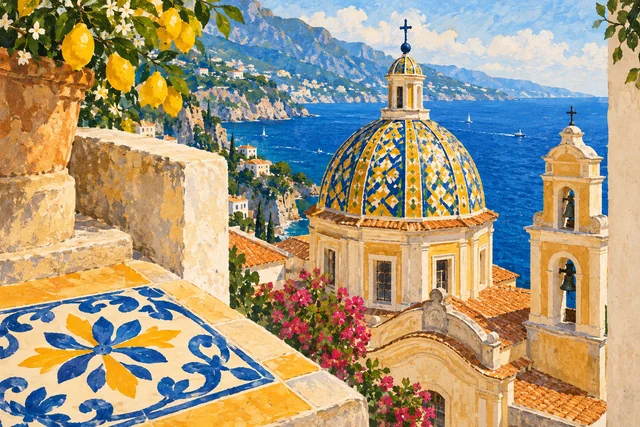
The official Amalfi Coast heritage project describes the church’s elevated position and the steep stair approach from Corso Reginna near Palazzo Mezzacapo. It also identifies the green-and-yellow tiled dome and records Santa Maria a Mare’s elevation to collegiate status in 1505. These details give you three useful things to notice: the relationship with the town below, the visible roof form and the institution’s history. You do not need to memorise a long sequence of dates to connect them.
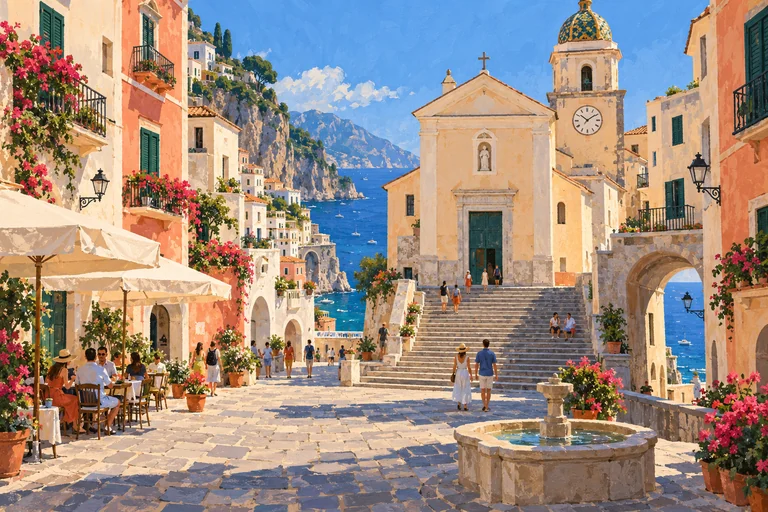
Pause where it is safe to do so and look back as the route rises. How does the church’s prominence change? Which parts of the town become visible, and which disappear? Treat those observations as your experience of the present landscape, rather than proof of how every earlier visitor approached. A stairway is a route through space, but its current surface and surroundings may reflect more than one period.
If steps, uneven surfaces or prolonged standing are difficult, seek precise access advice before committing to the outing. Ask about the actual entrance and route, not simply whether the town is accessible. A photograph of a terrace or dome cannot answer that practical question. Leave enough time to turn back or adjust the plan without making anyone feel that completing a climb is the measure of a successful day.
Separate a legend from a historical record
The heritage account connects the church’s name with a tradition that a Madonna-and-Child image was found at sea. Present that as a local religious legend, not an independently established account of an object’s journey. Legends can be important evidence of devotion and community identity without becoming literal travel reports. This distinction lets you appreciate the story while remaining honest about what kind of knowledge it provides.
Inside, if visiting is permitted, choose one relationship to study: the central ceiling and the space beneath it, the light falling towards the altar, or the way decoration directs your attention. The same heritage source describes a coffered ceiling and a crypt with sacred collections. Their existence does not establish that every area or museum route is open during your visit. Ask which spaces are accessible and whether any separate admission or accompaniment applies.
Keep worship at the centre of your behaviour. A service, preparation for a ceremony or a temporary closure can change the visitor route. Dress appropriately, lower your voice and follow photography instructions. Our guide to Amalfi’s cathedral museum considers the related question of how art-viewing and religious use share a place. At Praiano’s San Gennaro, tiles offer another way into coastal church architecture.
Confirm the opening, then enjoy one town
Maiori’s municipal information directs visitors to the archdiocese for current access and opening details. Follow that route rather than turning a general tourism description into a guaranteed timetable. A traditional feast mentioned in a historical account is also not a confirmed programme for your travel date. Check any current notice separately, especially if you hope to attend a celebration.
For organised transport, read our Amalfi Coast experience collection closely: a product must explicitly include the places and departure you need. If your journey also includes Naples, its day-planning collection helps compare a different base and starting point. Return to Maiori’s lower streets with time to spare. The most satisfying souvenir may be understanding how one church belongs to its town, rather than another hurried photograph of a dome.
Sources & further reading
Turn a good read into a great day.
Find a highly rated Sorrentine experience that brings these stories to life.
Explore related experiences →