What makes Sorrento’s Sedil Dominova an unusual public space?
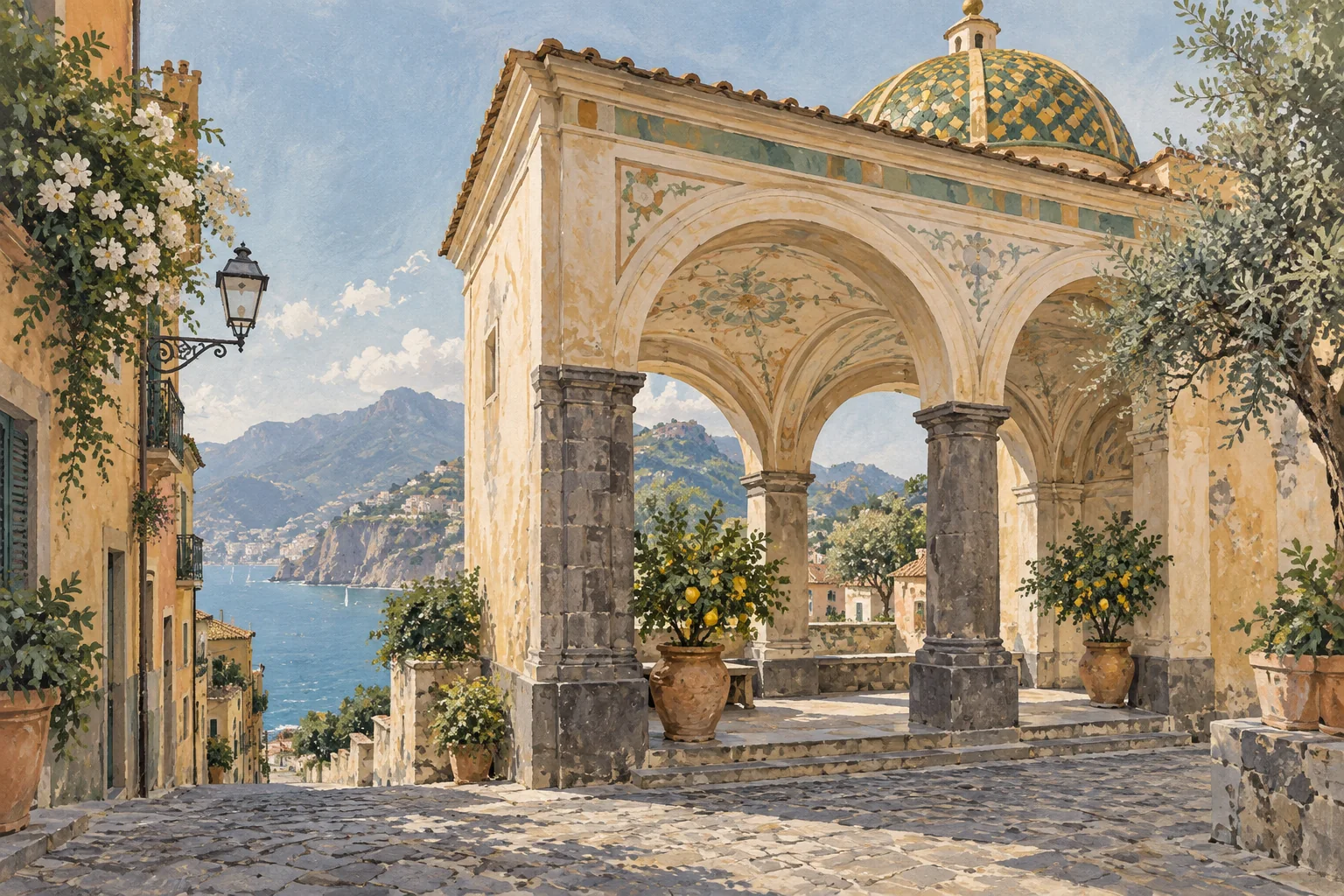
Sedil Dominova is easy to notice and easy to misunderstand. Its open arches and decoration can make it seem like a picturesque pause in Sorrento’s shopping streets. Look longer, and the building raises more interesting questions about who met there, whose affairs were discussed and how a space can gain a new public purpose without losing its older form.
Use it as a focused stop within our old-town looking guide. You do not need a long visit to appreciate it, but you will get more from a few attentive minutes than from treating the loggia as another photograph between shop windows.
Find the civic meaning behind the name
The municipality’s history of Sedil Dominova identifies the building on Via San Cesareo as a former gathering place for part of Sorrento’s nobility. It also explains the plaque naming the Società Operaia di Mutuo Soccorso, the workers’ mutual aid society founded in 1877. Those two uses belong to different social histories, even though they share one address.
That distinction is the key to the visit. The building’s openness does not mean that all inhabitants once possessed equal political influence there. Nor should an aristocratic origin obscure its later association with workers. Instead of asking only how old the loggia is, ask how the people using it changed what the place meant.
Look at the relationship with the street
Choose a viewpoint that leaves room for people passing through the lane. Notice how the arches allow you to see into a covered space without first crossing a conventional closed facade. Follow the curve of an arch to its supporting stone, then compare the solid corner with the open sides. These are useful observations even if you do not know the architectural vocabulary.
The local About Sorrento description discusses the piperno arches, later tiled dome and eighteenth-century painted decoration. Treat these as separate elements with their own histories. A building can retain an older structure while receiving a later decorative surface, just as a familiar room can change character without changing its outline.
For a wider Italian comparison, our guide to civic squares and gathering places considers the relationship between loggias, streets and public institutions. Sedil Dominova is a smaller setting, but the same questions help: who could gather here, how did the building frame that gathering, and how has its use changed?
Let decoration make you curious, not overconfident
Begin with what is actually visible: the direction of painted lines, the difference between a real opening and an illusion of depth, the placement of emblems above ordinary eye level. Then consult a reliable explanation for names and meanings. It is tempting to assign every symbol to a ruler or family immediately, but an attractive guess is still a guess.
Try looking first from the street and then, only where access is permitted, from a closer position. Does the decoration work differently at those distances? Which details announce themselves, and which reward patience? Our guide to San Francesco’s cloister offers another exercise in comparing covered and open spaces, with a very different institutional setting.
Read the plaque as carefully as the painted walls
The municipality emphasizes the mutual aid society’s records and correspondence as evidence for the lives of Sorrento’s working population. This brings the building into the history of practical cooperation: how people organized support, recorded decisions and represented their interests. The plaque is therefore more than a label added to a handsome older structure.
You do not need to enter a meeting room or inspect private records to appreciate that point. Read what is available publicly and respect any current boundaries. The society’s historic association with the building does not establish unrestricted visitor access today. If you want a specialist explanation or interior visit, ask the relevant organization what is currently possible before arriving with a group.
Connect civic life with the work of the town
Sorrento’s craft traditions provide one useful connection. Our introduction to inlaid wood and marquetry encourages attention to skilled labor, materials and the difference between making and selling. Carry that habit back to the loggia: towns are shaped by the people who work in them as well as by the patrons whose names appear on grand buildings.
For a guided context, compare our Sorrento walking tours and check whether Sedil Dominova is named. A stop outside may be all that an itinerary includes, which can still be worthwhile with a good explanation. Combine it with one other subject rather than a crowded sequence of interiors. The lasting pleasure of this small civic space is the way architecture, social change and an ordinary busy street remain visible together.
Sources & further reading
Turn a good read into a great day.
Find a highly rated Sorrentine experience that brings these stories to life.
Explore related experiences →